

Posts Tagged ‘Search Engine Optimization’
You must have thought of various ways to get more traffic to your Blog website. More traffic =more views=more revenue. In simple words you are looking out for various approaches to build traffic to your blog website. Here is one great strategy that will bring quality visitors to your website adding value to your business- usage of Long tail keywords.
What are Long tail Keywords?
 Long tail keywords are a type of keyword phrase that has at least three, and at times as many as five words in the phrase. Long tail keywords are used when you want to refine search terms and give specific information to the searcher. These keywords are highly specific, and attract less traffic for the website, but tend to draw more quality traffic, which leads in more conversions than normal keywords. Long tail keywords can also be used by publishers and visitors in different ways to benefit their business.
Likewise visitors are on the search for specific info and they type in long search terms to get closer to the topic they are searching for. Long tail keywords are less popular than short tail keywords also referred to as ‘Head words’. For eg: if you are looking for the generic term “paper bags”, you will have a large number of bidding websites and if you type in specific words “handmade paper bags online india” you will come across fewer sites and your search becomes easy.
10 Reasons to Use Long tail Keywords and Get More Traffic to your Blog website
New bloggers are not familiar with the concept of long-tail keywords and do not realize the immense potential these keywords can do to your Blog website. Long tail keywords is not complicated and the biggest advantage is that long-tail keywords benefit SEO too.
-
Less competition
Let us check the following key phrases:
paper bags online 4,79,00,000 results found on Google
handmade paper bags 39,00,000 results found on Google
handmade paper bags online 31,70,000 results found on Google
handmade paper bags online india 12,50,000 results found on Google

 This is a clear indication that longer search terms gives fewer sites to match i.e less competitive
-
Significant traffic
One long tail key word may not make all the difference by bringing tons of traffic and visitors to you website. However, long tail keywords are advantageous and can work miracles. You will get specific and important customers that will profit your business.
-
Better targeted traffic
Long tail keywords help to describe your requirement better. Foe g: when you describe a missing person you give as many details as possible such that identification will be easy. Similar is the case of long tail keywords: the better a phrase describes what you are looking for, the higher the chances that you will find just the product or service you need. Visitors who end up on your site after typing in long-tail keyword phrases are likely to be just the people you are targeting.
-
Higher conversion rates
The people searching with long term keywords are serious buyers and they are looking for specific info, their search normally converts better. Therefore, investing in long-tail keywords is often a dead sure ROI (Return On Investment) and a winning “quality over quantity” strategy.
-
Long-tails includes your head words
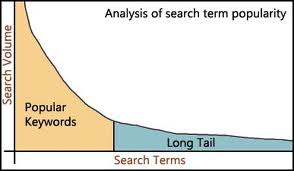 Long tail keywords already comprises the short keywords / head words which is also part of the search term keyed in by the visitor. For example “handmade paper bags online india” contains head words like ‘paper bags’ and ‘handmade paper bags’ in it. This way you are able to address 2 requirements in one shot.
-
Ideal for highly competitive niches
In some areas of business there is fierce competition. It is not easy to come on the top pages of Google SERP’s. Yet you can strike a smart deal by adding long tail keywords in your posts or website. This way your chances for getting higher on the search terms are brighter.
For eg: if you own a small hotel/ lodge in Hyderabad. There are plenty of lodges and hotels in the area and it will not be easy to trace you out. Forget the ranking, just look at how you can restrict the search by optimizing keywords to your benefit.
hotel near hyderabad airport : 1,88,00,000 results in Google(nearly half a billion)
budget hotel near hyderabad airport shamshabad : 4,12,000 results in Google
It doesn’t sound different but definitely the results look significant.
-
Long-tails beat personalization
These days results are getting more personalized, and custom tailored to a particular user’s geographical location, age, sex, interests, etc. Search results are based on locality of the user. Long-tail keywords can help you optimize your website for different categories of users, since long-tails are more specific. For eg: you can have a separate landing page for ‘handmade paper bags’ or ‘designer paper bags’. In short to minimize the negative effect personalization may have on your SEO, use more long-tail search terms for your SEO campaign
-
Perfect for PPC campaign
Most Internet marketers agree that PPC (Pay Per Click) advertising should be mostly long-tail. Basic reason: In PPC, you pay each time someone clicks on your ad. If you bid on non-specific, very general search terms you’ll have lower click-through rates and lower conversions. You will be wasting a lot of money on ill-targeted traffic. But, if you bid on more specific phrases i.e long tail keywords that better describe what you sell or offer, you are likely to attract just the right visitors to your site, and your PPC campaign will pay off sooner
-
Pick Ideas from Google Analytics
You will get ideas for long-tail keyword ideas straight from Google Analytics or any other Web analytics tool you are using. Besides, in Google Analytics you already see how many people came to your site by looking up a particular term, whether they converted or not – all that stuff. You will now agree that is another reason to put long-tails on your keyword list!
-
Simple and Easier to optimize
It is much more easy to conduct on-page optimization if you are including long-tail keywords. This is because, first of all, you will not require so many of them on the page. Second, a couple of long-tails look more natural in your website than do numerous short-tail terms. This provides a better user experience, and, again, helps conversions.
| If you are interested to own a Blog website Visit our Online Web Store and make your choice |
|---|
Hope these reasons will make you re-think and optimize your site for long-tail keywords. The mistake some SEO starters make is they just overlook long-tail search terms altogether, and miss out on some really great SEO opportunities. But, for sure, this will not happen to you, since now you know where the power of the long-tail keyword and the impact it can create in business blogging.
Related reading:
How to Increase Pageviews and Reduce Bounce Rate in WordPress
Tips to Use keywords to Rank High in Google Search Results
Top 10 ways to Increase Traffic to your Blog Website with Facebook
SEO – Optimize Post Titles to Get High Traffic
Tips to Increase Your Page Views and Get More Blog Traffic
 Keywords are the essence of an article. Keywords are single words, or even short phrases, which occur in a text more often. Keywords are the main source of Search Engine Optimization (S.E.O.) and combined with links to your site form an incredibly important part of how it will appear in the Search Engine Results Pages (S.E.R.P.).
Keywords are important for SEO as they actually describe the overall theme of any piece of published content such as an article, website or blog post. Key words help the Search Engines (Google, Yahoo!) “decide” how to categorize your website.
If you properly allocate the keywords into the content of the article, it will be tracked out by the Search Engines who are on the job day and night to cater to the internet users on the look out for information. Even if the article is not having great content , the incorporated keywords in your article will enable you surface out in top searches.
By correctly optimizing any content you publish on the Internet your article will rank higher in the search engine rankings through the proper use of keywords.
Beyond the importance of shooting for a page-one ranking, there are at least three additional reasons why the target keyword phrase is so critical.
- It will make up a significant portion of your headline and meta title — usually the first part of your article a potential reader will see. It’s in those nanoseconds when you’re most likely to hook or miss a potential reader.
- The research you put into choosing the target keyword phrase can trickle down to the rest of the article. What you don’t choose for the main phrase can become secondary keyword phrases that will enrich the article’s deck, intro, subheads, etc., further enhancing the article’s clout in search engines’ indexes.
- Studying the keyword phrases people search for will make you a better writer and/or editor. Simply put, the research gives you insight into how your potential audience thinks about and looks for information.
| If you are interested to own a Blog website Visit our Online Web Store and make your choice |
|---|
How to correctly use keywords to optimize any content you want to be easily found
- Learn the happening words. Every industry has its own jargon. If you’re well-versed in a particular subject, it’s likely that you already know the “buzzwords” and you don’t need to read up on them too much. If it’s a relatively new topic for you, do some research; read four or five different articles to get an idea of the lingo used and the most popular sub-categories of the industry. Reading is a great way to load up on catch-phrases and terminology. You can discover the keywords you need without even trying by reading lots of articles !
- Write the article without paying any attention to keywords. The first time you write an article, do not bother trying to plug keywords into an article. Just write it… Keep the flow going, make your sentences without paying particular mind to word selection and be creative. It’s likely that, if you know what you’re talking about, keywords will very naturally fall into place as you write. Those critical keywords… they tend to just slip right in without you even knowing it happened!
- Select your keywords. Once your first draft is written, you can concentrate on building a list of keywords to insert throughout your text. Sit down with a pen and paper (or a blank document if you prefer) and write down words that you frequently come across in the industry you’re covering. Imagine if someone were doing a search on the web for your topic. What words and phrases might they key in to the search box? Don’t forget search terms that contain two or more words. Such words work together and would be placed in quotes if someone were typing them into a search engine box. Suppose you were writing an article on email marketing. You would include terms like “drip list” and “email newsletter” to name just two.
- Assess the popularity of your keywords. Find out how many times Internet users searched the web using specific keywords, with the free Google AdWords Keyword Tool. Just type in the word, fill in the Captcha and hit enter. The more global or local searches, the more popular the keyword, and the more likely you’ll want to use it in your article.
- Select keywords that are specific rather than general. Let’s say I’m writing an article about negotiating fees with a freelance copy-writer. My goal should be to include popular words related to that particular topic, and not just the general category of copy-writing. “Freelance copy-writing rates” is a much better keyword phrase to use because that’s probably something a user would actually type in when searching for such information. “Freelance copy-writing,” on the other hand, is more general and therefore might bring up thousands of higher-ranked sites than yours. Burying your article is no way to be found… so, keep it specific if you can!
- Scan your existing text for keywords. Your article draft is complete and your keywords have been selected. Now, just put them together. Scan the article copy for the first keyword. Did you find it? Great! If you know your stuff, you probably slipped the keyword into a few places without even realizing it.
- Edit your content: Suppose in your article about copy-writing, you included the word “writing” several times throughout the content. That’s no serious problem by any means, but “copy-writing” is the term of choice among marketers and advertisers. Consequently, it should be one of your keywords. Find and make the following changes in your content. Check where you’ve used the word “writing” or “writer“, and replace with “copy-writing” or “copywriter.” Do this for each of your keywords and keyword phrases. After changes made you have to check and reframe some of the sentences, but this shouldn’t be a big deal.
- Your article needs proofreading. Now that you’ve added keywords, the article is probably somewhat different from its original form. Do a thorough read-through for mistakes, correcting as needed. Check for spelling errors, grammatical inconsistencies and repeated words. You need to watch out for repeated words, even in keyword articles. A good writer should try to vary his vocabulary. I said your article should be keyword-rich, not dull and repetitive!
- Keyword article headlines:You must always keyword article headlines! Get right to the point with a headline that uses your three or four most popular keywords at the beginning, not at the end. Allow me to critique an article. The headline: How to Negotiate Rates with a Freelance Copywriting Expert. This headline could have been better. Why? “Negotiate rates” is not a keyword term that someone might type into a search engine. “Freelance Copywriting,” however, is. The better version of this headline: “Freelance Copywriting: How to Negotiate Rates.” If the words were reordered, this headline would have been that much more powerful and achieved a higher web search ranking.
Avoid Using Keywords the Wrong Way
When you place keywords into your content you should be careful not to overuse these words or phrases. This is referred to as ‘keyword stuffing‘ and the Search Engines will penalize you for this by their refusal to list your content in the search results. True as it may be that proper keyword placement is vital if you want to be found by the Search Engines to earn a higher search ranking, deliberate overuse can get the writer penalized disallowing your content to be shown at all in the search results.
Keyword Density
Keyword density is a measurement or percent that reflects the use of a keyword within a piece of content. For instance, if you have a piece of content that is 300 words in length and you use a certain keyword 9 times the ‘keyword density’ is 3%.
Search engines use keyword density to score keyword use within content and generally dislike any percentages that approach or exceed 5%. In fact, as a writer, aiming for the mid-range of 3% or so should keep you in good standings while still maintaining a good search ranking.
A very handy tool you can use to measure the density of keyword usage in your content is http://www.live-keyword-analysis.com/. Just copy and paste your content into this site to check your keyword density.
Ideal Usage of Keywords
Now that we’ve discussed the acceptable percent range for our keyword use let’s focus on the optimal placement of them within the content itself. In general, a higher concentration of keyword use at the beginning of an article as an immediate notification of their use and at the end as a closing reminder is the most effective placement for keywords.
Properly using keywords in articles can boost your search engine rankings. The higher you rank the more exposure you’ll receive making your promotional efforts all the more effective.
Are you ready to prepare keyword article?
Many companies are using keyword articles to help their exposure on the Internet. Whether you’re a entrepreneur marketing a product or a writer seeking freelance work, odds are you can benefit tremendously from keyword articles.
Never written a keyword article before? Have no fear. The process isn’t much different from writing regular articles. Don’t let lack of experience stop you from profiting through keyword-rich content. Just follow these easy keyword-writing guidelines and get ready to key in some great article copy!
A Warning On Keywords!
Remember that while the optimization of your website is almost a science, you should never let the statistics of keywords get in the way of the art and quality of your content! If your content reads badly as a result of the keywords that you have added to it, then you have done the wrong thing. No one will link to content that does not read too well and this is the other half of S.E.O. You’re giving your visitors the keywords so that they can find your content to link to and it’ll be those links that pack massive S.E.O. punch.
To write keyword articles that get noticed, you must strike a balance between using keywords and useful content to increase Internet user knowledge about the information your company wishes to pass along. That is why you must always write your excellent content first before you consider the keywords.
You may have a good understanding on how to select keywords for your website and the appropriate usage. Go ahead, write keyword article and watch out how SEO is going to rank you.
| Follow us | |||||
|---|---|---|---|---|---|
 |
 |
 |
|||
 |
|
|---|---|
 |
|
 |
|
 |
|
 |
 |
 |
|
 |
|
Recent Posts

Verken de populairste casinospellen bij tower rush slot en verbeter je winkansen || Read More
March 6, 2026
Ultimate tips för att maximera dina vinster på casinot || Read More
March 6, 2026
Vinnande strategier för nybörjare i onlinecasinon || Read More
March 6, 2026
Как начать играть в казино руководство для новичков от лото клуб || Read More
March 5, 2026
Die historische Entwicklung der Casinos Ein Blick in die Vergangenheit von winnerz casino || Read More
March 5, 2026