

Posts Tagged ‘Google Search’
You must have thought of various ways to get more traffic to your Blog website. More traffic =more views=more revenue. In simple words you are looking out for various approaches to build traffic to your blog website. Here is one great strategy that will bring quality visitors to your website adding value to your business- usage of Long tail keywords.
What are Long tail Keywords?
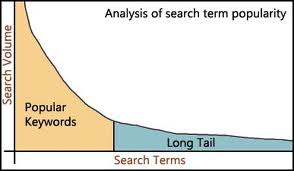
 Long tail keywords are a type of keyword phrase that has at least three, and at times as many as five words in the phrase. Long tail keywords are used when you want to refine search terms and give specific information to the searcher. These keywords are highly specific, and attract less traffic for the website, but tend to draw more quality traffic, which leads in more conversions than normal keywords. Long tail keywords can also be used by publishers and visitors in different ways to benefit their business.
Likewise visitors are on the search for specific info and they type in long search terms to get closer to the topic they are searching for. Long tail keywords are less popular than short tail keywords also referred to as ‘Head words’. For eg: if you are looking for the generic term “paper bags”, you will have a large number of bidding websites and if you type in specific words “handmade paper bags online india” you will come across fewer sites and your search becomes easy.
10 Reasons to Use Long tail Keywords and Get More Traffic to your Blog website
New bloggers are not familiar with the concept of long-tail keywords and do not realize the immense potential these keywords can do to your Blog website. Long tail keywords is not complicated and the biggest advantage is that long-tail keywords benefit SEO too.
-
Less competition
Let us check the following key phrases:
paper bags online 4,79,00,000 results found on Google
handmade paper bags 39,00,000 results found on Google
handmade paper bags online 31,70,000 results found on Google
handmade paper bags online india 12,50,000 results found on Google

 This is a clear indication that longer search terms gives fewer sites to match i.e less competitive
-
Significant traffic
One long tail key word may not make all the difference by bringing tons of traffic and visitors to you website. However, long tail keywords are advantageous and can work miracles. You will get specific and important customers that will profit your business.
-
Better targeted traffic
Long tail keywords help to describe your requirement better. Foe g: when you describe a missing person you give as many details as possible such that identification will be easy. Similar is the case of long tail keywords: the better a phrase describes what you are looking for, the higher the chances that you will find just the product or service you need. Visitors who end up on your site after typing in long-tail keyword phrases are likely to be just the people you are targeting.
-
Higher conversion rates
The people searching with long term keywords are serious buyers and they are looking for specific info, their search normally converts better. Therefore, investing in long-tail keywords is often a dead sure ROI (Return On Investment) and a winning “quality over quantity” strategy.
-
Long-tails includes your head words
 Long tail keywords already comprises the short keywords / head words which is also part of the search term keyed in by the visitor. For example “handmade paper bags online india” contains head words like ‘paper bags’ and ‘handmade paper bags’ in it. This way you are able to address 2 requirements in one shot.
-
Ideal for highly competitive niches
In some areas of business there is fierce competition. It is not easy to come on the top pages of Google SERP’s. Yet you can strike a smart deal by adding long tail keywords in your posts or website. This way your chances for getting higher on the search terms are brighter.
For eg: if you own a small hotel/ lodge in Hyderabad. There are plenty of lodges and hotels in the area and it will not be easy to trace you out. Forget the ranking, just look at how you can restrict the search by optimizing keywords to your benefit.
hotel near hyderabad airport : 1,88,00,000 results in Google(nearly half a billion)
budget hotel near hyderabad airport shamshabad : 4,12,000 results in Google
It doesn’t sound different but definitely the results look significant.
-
Long-tails beat personalization
These days results are getting more personalized, and custom tailored to a particular user’s geographical location, age, sex, interests, etc. Search results are based on locality of the user. Long-tail keywords can help you optimize your website for different categories of users, since long-tails are more specific. For eg: you can have a separate landing page for ‘handmade paper bags’ or ‘designer paper bags’. In short to minimize the negative effect personalization may have on your SEO, use more long-tail search terms for your SEO campaign
-
Perfect for PPC campaign
Most Internet marketers agree that PPC (Pay Per Click) advertising should be mostly long-tail. Basic reason: In PPC, you pay each time someone clicks on your ad. If you bid on non-specific, very general search terms you’ll have lower click-through rates and lower conversions. You will be wasting a lot of money on ill-targeted traffic. But, if you bid on more specific phrases i.e long tail keywords that better describe what you sell or offer, you are likely to attract just the right visitors to your site, and your PPC campaign will pay off sooner
-
Pick Ideas from Google Analytics
You will get ideas for long-tail keyword ideas straight from Google Analytics or any other Web analytics tool you are using. Besides, in Google Analytics you already see how many people came to your site by looking up a particular term, whether they converted or not – all that stuff. You will now agree that is another reason to put long-tails on your keyword list!
-
Simple and Easier to optimize
It is much more easy to conduct on-page optimization if you are including long-tail keywords. This is because, first of all, you will not require so many of them on the page. Second, a couple of long-tails look more natural in your website than do numerous short-tail terms. This provides a better user experience, and, again, helps conversions.
| If you are interested to own a Blog website Visit our Online Web Store and make your choice |
|---|
Hope these reasons will make you re-think and optimize your site for long-tail keywords. The mistake some SEO starters make is they just overlook long-tail search terms altogether, and miss out on some really great SEO opportunities. But, for sure, this will not happen to you, since now you know where the power of the long-tail keyword and the impact it can create in business blogging.
Related reading:
How to Increase Pageviews and Reduce Bounce Rate in WordPress
Tips to Use keywords to Rank High in Google Search Results
Top 10 ways to Increase Traffic to your Blog Website with Facebook
SEO – Optimize Post Titles to Get High Traffic
Tips to Increase Your Page Views and Get More Blog Traffic
How can I get my site top in Google search?
 The simple answer to this top question asked by hundreds of bloggers is by increasing the visibility of your blog website. For a regular person searching or finding data in Google they are entering in the search terms and accordingly sites will be displayed by Google .
The three major ways for strangers to find you on the web is:
Advertising: Online/offline advertising, Exchange advertisement programs, PPC (Pay-Per-Click) advertising, SEM (Search Engine Marketing), Article marketing etc
Referral links: Blogrolls, Directory listing, Forums, RSS/Feed directories, Social bookmarks, Social network links etc
Search Engines: Via Google, Yahoo, MSN, Ask etc
Among the three ways mentioned, ‘Search engines’ is the most popular method used by people to find information on the web. They search for data required by entering the associated terms or keywords. This is the most ideal and durable method to achieve high traffic consistently to your blog website.
In addition to this you need to optimize your site and its content. Your blog posts should be search engine friendly and easier for the search engines to track your blog with the help of search engine bots. This method is also known as Search engine optimization (SEO).
How do Search engines find information?
The blogosphere is filled with millions of websites and data connecting centers. The World Wide Web (WWW) is a giant storehouse of millions of interconnected PC’s and online information stored in them. Therefore to get your blog posts or website content probed and indexed by the search engines, you need to make your presence and existence known to them.
Your existence will be known by the search engine when you complete search engine submission for new sites or when other sites refer your website link via referrals. In both cases the search engine spiders , which is piece of software that reviews your site for its content periodically, needs to crawl all over your site and index its content for the benefit of the search users online.
| If you are interested to own a Blog website Visit our Online Web Store and make your choice |
|---|
How do Search engine spiders spread the web?
Your site is structured with two support systems that helps the search engine spiders to crawl and probe your site effectively.
- Robot.txt:
After you complete search engine submission for your new website, the search engine spiders ( also known as crawlers or bots) will try to navigate your site to understand its content. A robot.txt file maintained on your website will tell the spiders which all folders and modules on your web server are allowed to be crawled by them. This data is configured by the webmaster based on content.
It is great when search engines frequently visit your site and index your content but often there are cases when indexing parts of your online content is not what you want. For example, if you have two versions of a page (one for viewing in the browser and one for printing), you’d rather have the printing version excluded from crawling, otherwise you risk being imposed a duplicate content penalty.
A robots.txt file actually restricts access to the search engine robots that crawl the web to your site . These bots are automated, and before they access pages of a site, they check to see if a robots.txt file exists that prevents them from accessing certain pages.
- Sitemap.xml:
After the robot.txt allows spiders to crawl certain areas of your server folders, the sitemap.xml provides further information. The sitemap.xml file contains all your pages, posts, links to tools and web applications etc that need to be made visible to the public users (and finally to be indexed by the search engines).
Sitemap.xml will also contain more details on these pages such as when it was last changed, the priority of the page etc that help spiders to decide on when to index them.
To summarize robot.txt provides folder /file level access details and Sitemap.xml provides detailed information on pages. These two files are very important for any blog website that is search engine friendly and they are usually maintained at the root folder of your website.
In addition to robots.txt and Sitemap.xml file, there are page and link level instructions that help spiders to decide whether to index a page or a target page that is pointed to by a link on the page (URL). These are page meta tags and link properties.
Submitting your new website to blog directories does not automatically mean that you will top in Google Search, you need to fulfill these basic requirements. Go thru’ this article: How to Rank your Website High in Google’s Search Engine for better insight. You will be able to see your blog website ranked high in Google Search.
| Follow us | |||||
|---|---|---|---|---|---|
 |
 |
 |
|||
 |
|
|---|---|
 |
|
 |
|
 |
|
 |
 |
 |
|
 |
|
Recent Posts

Explorarea completă a jocurilor de noroc la ice fishing game || Read More
March 10, 2026
Şans mı, yoxsa bacarıq mı Kazinonun sirrləri açılır || Read More
March 10, 2026
Psychologické aspekty hazardu Jak ovlivňují naše rozhodování || Read More
March 10, 2026
Exploring the Complete Casino Experience A Comprehensive Overview of casino spinlander || Read More
March 10, 2026
Texnologiyanın oyun dünyasına təsiri 1win ilə dəyişən mühit || Read More
March 9, 2026